
Oriental Art
National and international collectors have found Cordy’s to be the most favoured auction house to watch for a broad range of Chinese porcelains, jades, ivories, bronzes and wood. Items of quality and age are met by a knowledgeable audience in our rooms. We also specialise in Japanese ukiyo-e, scroll paintings, textiles, Peking glass and Chinese silver.
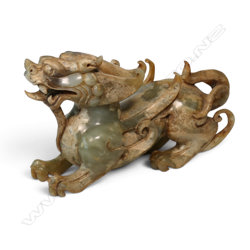
Reputedly old Chinese hand carved jade bixie,
finely carved in pale to mid green jade with cloudy inclusions. The beast with tongue extended and scrolling mane, wings and tail. L.240mm. Small repair to one ear. Note: A bixie is a mythological winged creature whose name translates to 'warding off evil spirits'. Provenance: Ex. The personal collection Mr Jun Tsang, Hongkong. With associated brochure stating as being 'No.102 Han Dynasty Jade Bixie (mythical beast).' From a private Bay of Plenty estate being sold by Cordy's which includes a large collection of bronze Buddha.
Realised: $11,500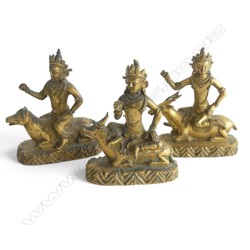
3 INDIAN GILT METAL FIGURES ON ANIMALS H.60mm
Realised: $8,400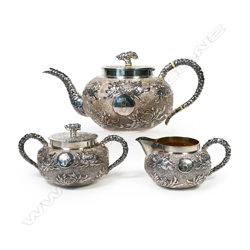
A Wang Hing c.1900 Chinese silver three-piece tea service,
relief embossed and engraved chrysanthemum decoration. Finely worked, gilt interiors. 1022gms. Note: The name Wang Hing is synonymous with quality and design. Established in Canton in 1854, by the wealthy Lo merchant family. The establishment of the Treaty of Nanking helped fuel the market for China’s export trade. From there export silver changed from European designs to feature traditional Chinese motifs, patterns and symbols. This would prove to be popular with Western retailers and consumers, as orientalism became the new fashion.
Realised: $5,800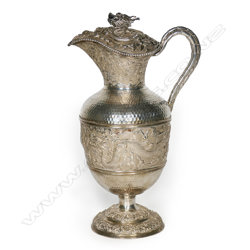
19thC elaborate Chinese silver wine decanter attributed to Tu Mao Xing,
baluster pedestal form. The hinged lid with a sculpted dragon on blossom form clouds, bamboo to the neck, dimpled shoulder. The body with a band on confronting dragons flanking a mystic pearl, conforming decoration to the base. H.265mm. 877gms. Maker's marks to interior of lid
Realised: $5,500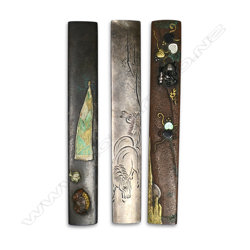
Three Japanese kozuka hilts,
two shibuichi examples decorated in relief with enamel, both signed, and a .950 silver example engraved with horses. Provenance: Rolf Walter Renker Collection (1927 – 2025), Düsseldorf. Renker family by descent. L.97mm.
Realised: $5,000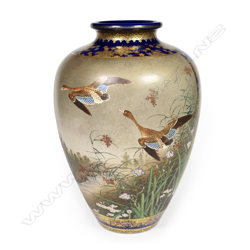
Large Japanese Meiji Satsuma vase,
of ovoid form, with two large panels of finely painted bird decoration with fine speckled gilt to their tops, fowl to one panel with falling wisteria, geese in flight to the other. The cobalt blue ground with gilt highlights. Gilt on red mark to the base for Kinkozan tsukuru. H.310mm.
Realised: $4,800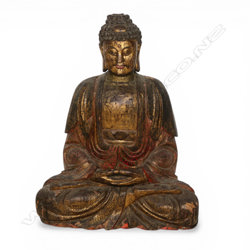
A vintage wooden and gildeed Buddha,
in serene lotus position, remains of gilding and painted finish. 650 x 390 x 800mm.
Realised: $4,400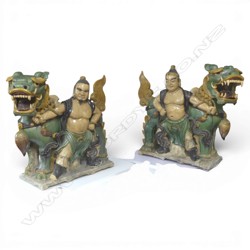
PR VINTAGE ORIENTAL CERAMIC LARGE TEMPLE FU LIONS, ONE WITH FAULTS AND RESTORED PARTS 700x300x600mm
Realised: $3,600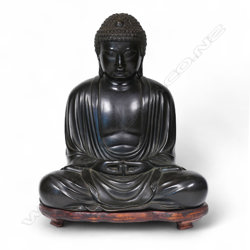
A fine quality Meiji period Japanese bronze buddha,
seated in traditional serene pose, on wood base, seal marks to base. H.330mm. Provenance: Richard Rice estate collection.
Realised: $2,700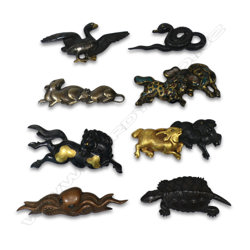
A collection of eight Japanese menuki,
copper alloy with gilded detailing. Provenance: Rolf Walter Renker Collection (1927 – 2025), Düsseldorf. Renker family by descent. L.45mm.
Realised: $2,600